Grammy-nominated Eric Gales & Audible Steel™ Saddles

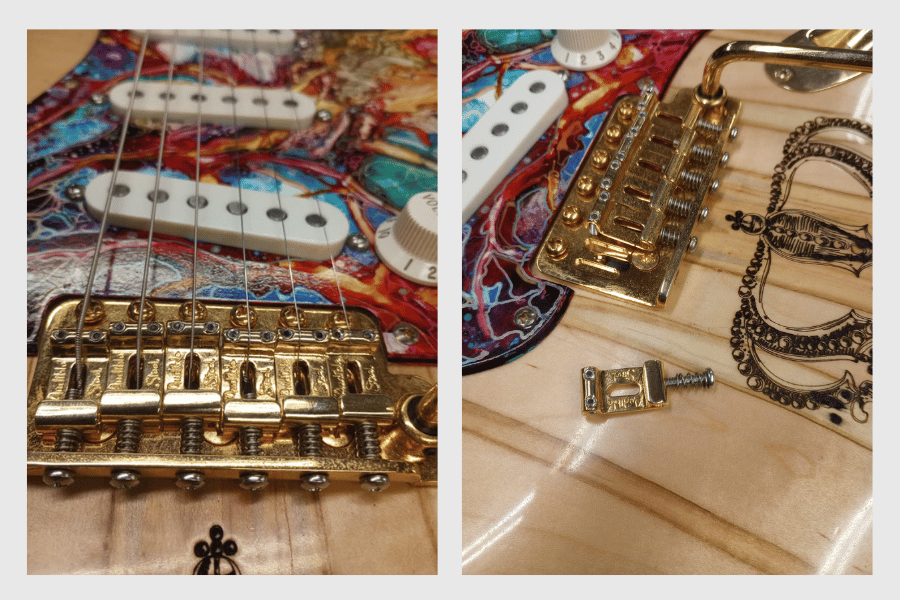
This is a story about Grammy-nominated Eric Gales and his special 24K gold-plated Audible Steel™ S-style guitar saddles.

Last fall, the legendary Larry Walker forwarded a set of Audible Steel™ saddles for evaluation to master builder Eric Gale of Freestyle Custom who is building the Eric Gales Nation guitar.

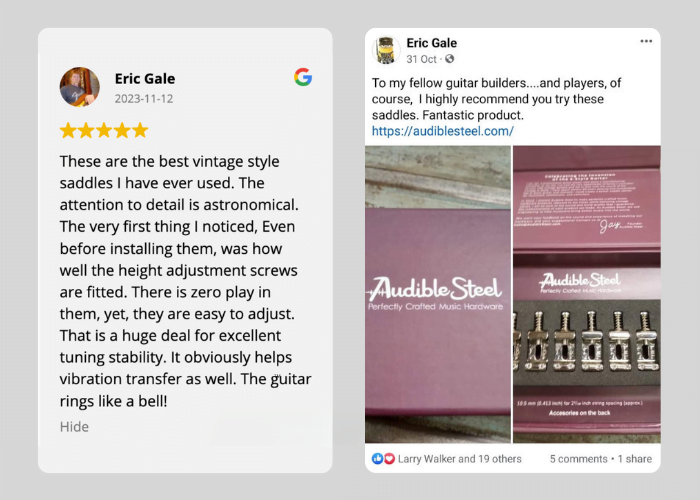
Eric was so impressed with the saddle build and attention to detail that he decided to use them for the Eric Gales Nation custom-build (and he immediately ordered 4 more sets for his other clients).

We are excited to share Larry’s announcement on Eric Gales Nation about this decision:

“Would like to give a shout out to Jay Dasgupta of Audible Steel. Jay’s S-style saddles are hand crafted works of art. After testing them out by Eric Gale it was decided that these were going to have to be included in the Eric Gales Nation guitar build.

Many of you may recognize Eric Gale of Freestyle Custom guitars. Eric hand crafted the Crown guitar a couple years ago for Eric Gales which was used on the Crown Tour.

Because Eric Gales likes his hardware on his guitars to be gold Jay at Audible Steel made EG exclusive 24k gold plated saddles and needless to say Eric was blown away! He is so looking forward to trying them out on the Eric Gales Nation guitar upon its completion. Stay tuned for that!”

We’d like to thank Larry Walker for bringing us all together. 

And a big thank-you to Eric Gales for this huge opportunity — we look forward to your usual magic on this guitar!

READ MORE

The Story of Our Corrosion-Resistant Finish

Guitar saddles are located in the part of the guitar that’s naturally humid. The hand, as it plays, gets sweaty. Sweat is salty, and salt water is one of the most corrosive elements.

In my sheet metal manufacturing business, I’ve been using the standard salt spray test to check the corrosion resistance of materials and surface coatings of all our industrial products. And as a professional guitar player, I know I put my guitar saddles through a salt spray test every time I play! 

Being at this intersection of music and manufacturing with deep experience in both has allowed me to select the most appropriate metal and finish of our S-style guitar saddles. 

At Audible Steel we use a plating method for the surface finish that holds up to regular exposure to salt, grime and humidity. Because I know that these saddles will go through the salt spray test every day of their lives!

READ MORE

Handcrafted saddles for handcrafted guitars

Check out this amazing video from Eric Gale of Freestyle Custom : Handmade Guitars. 

People order “forever guitars” from him – an instrument they’ll treasure for the rest of their lives. Eric custom-builds the entire instrument from start to finish, from using exotic woods, designing the fretboard, and accommodating any special requests.

Because our product is also hand-crafted, we understand and admire his work. And we are very proud that he chose our Audible Steel™ saddles for his custom guitars!

When we told him this, Eric replied: “It somehow seems your saddles chose me! Hand crafted saddles for a hand crafted guitar!” 

Love the response ❤️

READ MORE

What makes the Audible Steel saddles different?

The Audible Steel saddles are designed for musicians by a musician (me). My design includes these 4 benefits:

  • Enhanced Tone
  • Improved Resonance 
  • Tuning stability
  • Minimize string breakage at saddle end

I’ve been playing the guitar professionally for more than 35 years, and the Strat is my favorite. 

However, there were a couple of things that bothered me as a professional musician. One was that the strings tended to break at the saddle end. The other was the tuning instability, especially when using the tremolo. 

In addition, I noticed some variations in vintage Strat saddle design. When I was serving as the caretaker of a large collection of vintage Stratocasters, I had noticed that the vintage saddle steel gauges were not consistent. This meant that each vintage guitar had a unique tone. 

Since I also have deep experience in sheet metal manufacturing, I researched each of these issues, and designed and tested prototypes to address them. I tested my saddle prototypes on a number of these vintage Strats. 

My final design addressed these manufacturing variations and enhanced the sound of a good Strat. The Audible Steel™ saddles bring out a range of pretty frequencies and an overall improved sustain and tuning stability. 

If you listen to this video (below) with a nice pair of speakers you’ll hear the improvement that I’m talking about. We have not used anything in the signal chain except a basic reverb.

Note: Our saddles are compatible with all S-style and some T-style guitars.

READ MORE

Excellent tuning stability for your S-style guitar

The saddles of a guitar are responsible for the sound quality, and to a large extent, for increasing the resonance. It also plays a key role in the clarity of the note and the stability of the tuning – especially when using the tremolo. The tiny details that have gone into perfecting the design of our Audible Steel saddles deliver tuning stability. Check out this video to see what we mean.

READ MORE

Do the outer strings of your vintage Stratocaster slip off?

Have you ever had the outer strings of your vintage Stratocaster slip off the edge of the fretboard while you’re playing?

This is because some 50s and 60s Strats may have tiny variations in fretboard width. 

The typical vintage Stratocaster guitar string spacing is supposed to be 2-7/32 inches. But in some cases, this string spacing varies slightly. In addition, the variation is not the same from instrument to instrument.

In such cases, the outer strings (low E and high E) are too close to the edge and tend to slip off the fretboard area — which not only makes playing difficult but also affects the notes.

The solution to this problem lies in the “middle width” guitar saddles.

  • The vintage Strat saddle width is 0.441” (11.2 mm) for 2-7/32 inches string spacing.
  • The contemporary S-style guitar saddle width (0.413” or 10.5 mm) for 2-1/16 inch string spacing started showing up in the 1980s Asian imports. 
  • After that, a new “middle width” S-style guitar saddle emerged, which is between the vintage and the contemporary saddle widths.

This “middle width” saddle (0.425” or 10.8 mm) is the solution because it brings the outer strings on a vintage Strat a tiny bit closer and prevents them from slipping off the edge of the fretboard. 

Give it a try.

READ MORE

How to figure out the right saddle size for your guitar

The string spacing of your S-style guitar indicates which saddle size you need. Therefore, the first step is to identify your string spacing. 

The easiest way to figure this out is by measuring the space between the 2 outer strings of your guitar. Measure at the bridge using a digital caliper.

  • If the string spacing is 56 mm (2-7/32 inch), use 11.2 mm (0.441 inch) saddles
  • If the string spacing is 54 mm (2-1/8 inch), use 10.8 mm (0.425 inch) saddles
  • If the string spacing is 52 mm (2-1/16 inch), use 10.5 mm (0.413 inch) saddles

You can also determine string spacing through the guitar model. Check the serial number on your guitar and search online to find the model.

  • Vintage Stratocasters manufactured from the 1950s through the mid-60s have 2-7/32 inch string spacing, and therefore use 11.2 mm (0.441 inch) width saddles. Audible Steel model A112.
  • Most contemporary S-style guitars manufactured from the 1980s onward have 2-1/16 inch string spacing, and therefore use 10.5 mm (0.413 inch) width saddles. Audible Steel model A105.
  • Some modern “vintage re-issues” have the 2-7/32 inch string spacing, so these also use 11.2 mm (0.441 inch) width saddles. Audible Steel model A112.

NOTE: If your string spacing is just slightly less than 2-7/32 inch, it means your guitar probably has the vintage 11.2 mm sized saddles. However, you will fare better with the 10.8 mm sized saddles. Audible Steel model A108.

The “middle size” saddle for S-style guitars 

Initially there were two standard saddle sizes: vintage and contemporary. A third “middle size” (10.8 mm) emerged over the years which is between the vintage and the contemporary sizes, and is made for 2-1/8 inch string spacing. This size also solves a particular problem with the vintage for 2-7/32 inch string spacing. See our article on this topic for details.

READ MORE